Sunglasses size guide: compare frame measurements
Compare stated frame dimensions with glasses you already wear.
Lens width difference
+2 mm
3 of 4 dimensions compared
3 of 4 dimensions compared. Differences are candidate minus reference.
Candidate minus reference
| Dimension | Reference | Candidate | Difference |
|---|---|---|---|
| Lens width | 52 mm | 54 mm | +2 mm |
| Bridge width | 18 mm | 17 mm | -1 mm |
| Temple length | 140 mm | 145 mm | +5 mm |
| Stated total width | 136 mm | Not entered | Needs both values |
Positive means larger or longer; negative means smaller or shorter. Dimensions alone do not predict fit.
Read the numbers on a frame
This sunglasses size guide compares frame dimensions with a pair you already wear. Enter each frame’s stated measurements to see the difference in matching dimensions.
The fictional maker specification in this example is 52-18-140, with a separate total width of 136 mm. The drawing labels each dimension. Its proportions are schematic.
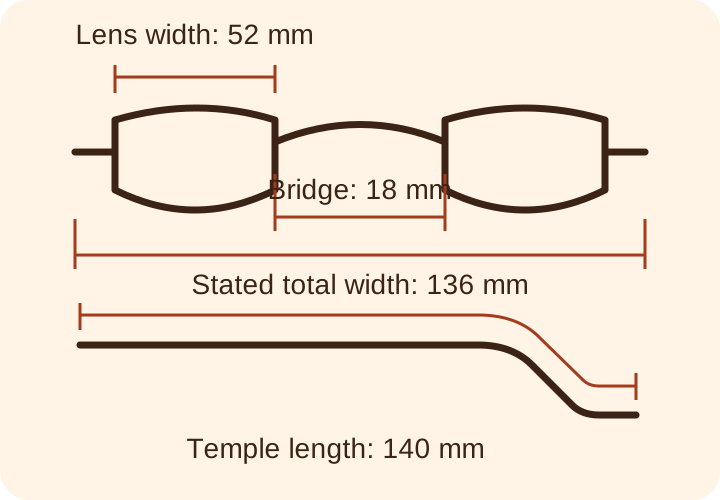
The first number is the horizontal width of one lens. The second is the distance between the lenses. Temple length runs from the hinge to the arm’s tip, including its bend.
These labels follow Warby Parker’s frame measurement guide. Find the numbers inside the arm or in the maker’s specification for the exact model and size.
Total width is a separate measurement across the front, including the frame’s outer edges. Adding two lens widths to bridge width leaves out the outer frame and endpieces.
For example, 52 + 52 + 18 equals 122 mm. Calling that the example’s total width is incorrect. Its fictional specification states 136 mm.
A frame code describes the frame. A lens prescription describes optical correction. Pupillary distance measures the space between pupils, and an optician uses separate measurements to position lens optical centres.
Compare a candidate with a known frame
Choose the unit printed on each frame’s specification. The worksheet converts both sets to millimetres before subtracting the reference measurement from the candidate measurement.
One centimetre is 10 mm and one inch is 25.4 mm. Changing a unit converts the existing entries, so the physical dimensions stay the same.
| Dimension | Reference | Candidate | Candidate minus reference |
|---|---|---|---|
| Lens width | 52 mm | 54 mm | +2 mm |
| Bridge width | 18 mm | 17 mm | -1 mm |
| Temple length | 140 mm | 145 mm | +5 mm |
| Stated total width | 136 mm | Not entered | Needs both values |
The example compares three dimensions. Its candidate lenses are 2 mm wider, the bridge dimension is 1 mm smaller and the arms are 5 mm longer.
The candidate’s total width stays missing. Entering a blank as zero would create a false difference. A missing field needs the matching value before that row can be compared.
Sunglasses and optical frames can use the same dimension labels. This glasses frame size guide compares those labels without assigning a universal small, medium or large size.
Two frames with matching numbers can still feel different. Frame shape and material affect how they sit. Nose-pad adjustment and the temple bend also affect contact with the face.
The CSV keeps numerical values in millimetres and labels the subtraction direction. Share it with the exact model names and sizes so the retailer can identify the frames.
Check the real frame and preview limits
Use the comparison to identify differences to discuss with the retailer. The maker’s specifications must use the same measurement definitions for those differences to be useful.
Confirm the exact model and size before ordering. Ask about the bridge design, nose pads and adjustable parts. Try the frame to check pressure, slipping and contact with the cheeks.
Warby Parker’s fitting guidance separates the frame dimensions from how glasses sit on a person. A matching code cannot establish comfort.
For prescription glasses or prescription sunglasses, ask an optician to check the frame’s suitability for the chosen lenses. Optical-centre positioning and lens-height requirements need their own assessment.
This worksheet uses dimensions you enter manually. It does not measure your face or analyse a photograph. An appearance preview shows how a frame looks in an image.
Keep the preview and dimension comparison separate when helping a customer choose. Confirm physical fit and prescription suitability with the real frame and the relevant professional checks.